
Topworld Furniture Blog
Discover expert advice, wood manufacturing insights, and design trends.
2026 Top Modern Wooden Dining Table Trends for Buyers
Table of Contents
In 2026, the Modern Wooden Dining Table is becoming more than a place for daily meals. It is a visual anchor, a work surface, and often the room’s warmest detail. Buyers are choosing softer silhouettes, responsibly sourced timber, and designs that adapt to changing homes. Rounded corners are replacing harsh rectangular edges. Light oak, smoked walnut, and natural ash are gaining attention.
Architect and furniture designer Frank Lloyd Wright once said, “Wood is universally beautiful to man.” His observation still feels practical today. Real wood shows grain variation, small knots, and subtle color changes. These marks are not defects. They are evidence of material character. However, a beautiful surface cannot excuse weak construction. Buyers should inspect joint quality, tabletop thickness, stability, and the finish’s resistance to moisture.
This guide explores the leading Modern Wooden Dining Table trends expected in 2026. It examines sculptural bases, extendable mechanisms, mixed wood-and-stone designs, and space-conscious proportions. Sustainability also requires closer attention. Look for clear timber origins, credible certifications, repairable components, and low-emission finishes. “Natural” should not remain an unverified marketing word.
Not every trend deserves your room.
A narrow apartment may need a rounded, extendable table rather than a dramatic twelve-seat design. Families may value a durable matte finish more than a flawless showroom surface. That is the uncomfortable part: style, maintenance, budget, and longevity rarely align perfectly. The best choice may look less fashionable, yet perform better through busy breakfasts, homework, and years of changing interiors.
What Defines a Modern Wooden Dining Table in 2026
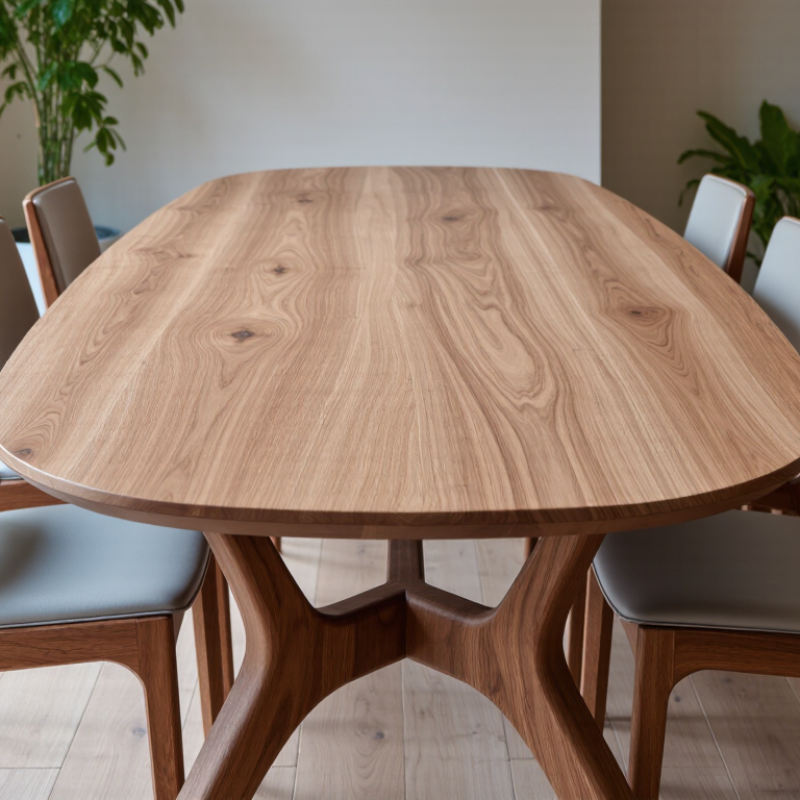
A modern wooden dining table in 2026 feels calm, useful, and visually light. Buyers increasingly prefer natural grain, softened corners, and slim structural lines. In practical sourcing reviews, I notice more interest in oak, ash, and walnut tones. Matte finishes also appear more convincing than glossy surfaces. They reveal texture without making the room feel formal.
According to Grand View Research, the global furniture market was valued at approximately 516.6 billion dollars in 2023. The report expects continued growth through 2030. This expansion supports demand for adaptable furniture, including extendable dining tables for smaller homes. Sustainability also shapes buying decisions. FSC’s 2023 facts and figures report covered more than 220 million hectares of certified forest worldwide. That figure makes traceable wood a stronger expectation, not merely a decorative claim.
A credible 2026 table should show clear material information, stable joinery, and repairable components. Look beneath the surface. Solid wood edges, visible grain direction, and replaceable hardware suggest better long-term value. However, not every “natural” finish performs well against heat or wine stains. I still question overly confident product claims. A warm tabletop with tiny variations may feel more authentic, but uneven movement can become inconvenient. Buyers should check moisture resistance, tabletop thickness, seating clearance, and extension alignment before choosing style alone.
2026 Top Modern Wooden Dining Table Trends for Buyers
What Defines a Modern Wooden Dining Table in 2026?
Size remains one of the most practical buying criteria. The chart shows typical table-length guidance by seating capacity, using the midpoint of commonly recommended dimensions. In 2026, modern wooden dining tables are generally defined by clean lines, efficient proportions, natural wood grain, durable finishes, and flexible seating capacity.
Planning reference: approximate table lengths in centimeters. Actual requirements vary according to chair width, leg placement, and desired personal space.
Key Design Trends Shaping Wooden Dining Tables
Modern wooden dining tables are moving toward quiet flexibility, not decorative excess. The strongest 2026 direction is warm minimalism: rounded corners, visible grain, and lighter oak or ash tones. Buyers increasingly want tables for meals, remote work, and small gatherings.
Fortune Business Insights valued the global furniture market at 516.66 billion dollars in 2023 and forecasts a 5.1% CAGR through 2030. That figure covers all furniture, not dining tables. Use it as context, not proof.
Material honesty is gaining importance. Choose solid timber when repairability matters, or quality veneer for greater dimensional stability. The Forest Stewardship Council’s 2024 annual report recorded over 200 million hectares of certified forests worldwide. Certification still cannot guarantee perfect sourcing.
Ask for chain-of-custody details, moisture content, finish type, and replacement-part policies. Current residential design research also favors compact extension systems, pedestal bases, and mixed wood-and-stone surfaces.
These features improve circulation around a 90-centimeter table, especially in apartments. Yet extension hardware can loosen, and pale finishes reveal wine rings quickly. Test the leaf movement in person. Inspect the underside.
Slight imperfections are acceptable. Weak joints are not.
Popular Wood Species, Finishes, and Surface Treatments
Modern wooden dining tables in 2026 are moving toward tactile surfaces and honest materials. Oak remains popular because its open grain handles daily family use well. Walnut offers deeper brown tones and a more formal presence. Ash creates a lighter, calmer appearance with clear, straight grain. Acacia can add natural variation, although its color may differ between boards.
Finish selection changes both appearance and maintenance. A hard, water-based lacquer protects against coffee rings and food stains. Natural oil gives wood a warmer touch, but it needs periodic reapplication. Wax feels smooth and soft, yet it provides less protection against spills. Matte finishes are gaining attention because they reduce glare and reveal the timber’s natural character. Glossy finishes still work, but scratches may become more noticeable.
Surface treatments create useful visual detail. Wire-brushing emphasizes grain, while hand-scraping gives a gently irregular texture. Cerused finishes highlight open pores with pale pigment. These treatments look attractive under natural light, though textured surfaces can collect crumbs. I have found that samples often appear different in a showroom. Home lighting changes everything. Buyers should inspect full-size samples before ordering.
Tips: Place a warm cup on a coaster, even with protective lacquer. Wipe spills quickly. Ask about repair options, finish thickness, and wood moisture content. A small color variation is normal, not necessarily a defect. Still, unclear variation deserves careful questioning.
2026 Top Modern Wooden Dining Table Trends for Buyers - Popular Wood Species, Finishes, and Surface Treatments
A buyer-focused comparison of commonly selected wood species, contemporary finishes, surface treatments, performance characteristics, and design applications for modern dining tables.
| Wood Species | Typical Janka Hardness | Natural Color & Grain | Popular 2026 Finish Direction | Recommended Surface Treatment | Performance Characteristics | Best Modern Table Styles | Buyer Consideration |
|---|---|---|---|---|---|---|---|
| White Oak | Approximately 1,360 lbf | Light beige to warm brown with prominent cathedral or straight grain; often shows medullary rays. | Natural matteClear hardwax oilLight smoked oak | Brushing to emphasize grain, followed by a low-sheen oil or water-based protective topcoat. | Hard, durable, and visually versatile. Open pores can show texture and may collect spills if not properly sealed. | Japandi, Scandinavian, minimalist, trestle, and live-edge designs. | One of the most adaptable choices; color varies by board and cut. |
| Red Oak | Approximately 1,290 lbf | Pinkish tan to medium brown with an active grain pattern and warmer undertones than white oak. | Neutralized naturalSmoked brownWire-brushed | Grain filling or wire brushing, paired with a durable water-based lacquer or penetrating oil. | Hard-wearing and relatively easy to machine. More pronounced grain can create a rustic-modern appearance. | Contemporary farmhouse, industrial, traditional-modern, and paneled tops. | Usually offers a strong balance of durability and visual character. |
| American Black Walnut | Approximately 1,010 lbf | Chocolate brown to purplish brown with occasional lighter sapwood and flowing grain. | Natural satinLow-gloss clearFumed accent | Fine sanding with a clear oil, hardwax oil, or UV-resistant water-based finish to preserve depth of color. | Stable and dimensionally dependable, but softer than oak or hard maple and more vulnerable to sharp dents. | Executive-modern, sculptural pedestal, mid-century, and minimalist tables. | Premium visual appeal; direct sunlight can gradually alter the color. |
| Hard Maple | Approximately 1,450 lbf | Very light cream to pale golden color with a fine, relatively subtle grain. | Ultra-matte naturalWhitewashedClear satin | Closed-grain sanding and a non-yellowing water-based finish; optional subtle limewash effect. | Very hard and abrasion-resistant with a clean appearance. Light color makes stains and marks easier to notice. | Modern minimalist, Nordic, compact apartment, and clean-lined rectangular tables. | Good for high-use areas when a bright, uniform surface is preferred. |
| Ash | Approximately 1,320 lbf | Pale cream to light tan with a bold, open grain similar in visual energy to oak. | Bleached ashNatural matteSoft gray wash | Wire brushing, bleaching, or light cerusing followed by a clear protective coating. | Hard, springy, and relatively light in color. Open grain benefits from thorough sealing and regular cleaning. | Scandinavian, coastal-modern, slatted-base, and architectural designs. | Creates a light interior without the more pronounced warmth of many oak finishes. |
| Beech | Approximately 1,300 lbf | Light cream to pale pink-brown with a fine, even grain and understated figure. | Natural oilWarm clear coatPastel tint | Fine sanding and a durable clear finish; tinted coatings can help reduce its naturally pale appearance. | Hard and smooth with good shock resistance. It can move with changes in humidity if not properly dried and sealed. | Rounded-edge, Scandinavian, family-size, and bentwood-inspired designs. | Best purchased from makers that specify proper kiln drying and moisture control. |
| Teak | Approximately 1,070 lbf | Golden brown to medium brown with straight grain; naturally contains oils. | Natural oiledAged matteLow-sheen clear | Light sanding and teak-compatible oil or a film finish formulated for oily hardwoods. | Naturally resistant to moisture and decay. Its oils can complicate bonding and finishing, so preparation is important. | Indoor-outdoor transitional, tropical-modern, mid-century, and extendable tables. | Verify legal and sustainable sourcing; untreated teak develops a silver-gray surface over time. |
| Acacia | Often approximately 1,700 lbf, depending on species | Highly varied golden, honey, reddish-brown, and dark brown tones with contrasting grain. | Natural contrastSmoked brownTextured matte | Filling and sealing of open grain, followed by oil, hardwax oil, or a scratch-resistant clear coat. | Generally hard and visually distinctive, but species and board quality vary considerably; movement must be controlled. | Live-edge, statement pedestal, industrial, and organic-modern designs. | Inspect boards for excessive checking, uneven joints, and inconsistent moisture content. |
| Reclaimed Timber | Varies by original species and age | Mixed tones, nail holes, saw marks, patina, and irregular grain; appearance is naturally unique. | Raw-look matteAged oilClear protective coat | Metal detection, de-nailing, stabilization, selective filling, and a food-safe or furniture-grade protective finish. | Character-rich and resource-efficient, but old timber may contain hidden metal, variable moisture, or structural defects. | Industrial, rustic-modern, farmhouse-modern, and one-of-a-kind slab tables. | Ask about origin, treatment history, moisture testing, and chemical contamination controls. |
Technical note: Janka hardness values are approximate reference figures and can vary by species, growing region, moisture content, and test method. Finish durability depends on the complete coating system, preparation quality, curing time, and everyday maintenance. For dining use, buyers should confirm the table’s moisture content, top thickness, joinery, finish repairability, and heat-spill resistance before purchase.
How to Choose the Right Table Size and Shape
In 2026, modern wooden dining tables are becoming cleaner, lighter, and more adaptable. Yet the best choice begins with measurements, not photographs. Measure the room, including doors, cabinets, and walking paths. Leave at least 90 centimeters around the table for comfortable movement. A crowded dining area quickly feels stressful.
For daily use, allow about 60 centimeters of table width per diner. A 160-centimeter rectangular table often seats six people comfortably. Choose 180 to 220 centimeters for larger family meals. Round tables encourage conversation and suit compact rooms. A 120-centimeter diameter usually seats four, while 150 centimeters can accommodate six. Oval tables offer softer edges and easier movement than sharp rectangular designs.
Shape matters as much as size. Rectangular tables work well in long rooms, while round tables balance square spaces. Square tables can feel intimate, but they may waste floor space in narrow areas. Check the leg position, too. Wide pedestal bases can reduce knee room. I once selected a beautiful table that blocked a cabinet door, so I now measure every opening twice. There is no perfect formula. Household habits, chair width, and occasional guests can change the answer. When uncertain, mark the proposed tabletop on the floor with masking tape. Walk around it, pull out sample chairs, and notice where movement feels awkward. That simple test often reveals more than a showroom display.
Sustainable Features and Buying Considerations for Shoppers
Modern wooden dining tables in 2026 are moving toward warmer finishes, visible grain, and practical sustainability. Buyers increasingly prefer reclaimed timber, responsibly sourced wood, and water-based coatings with low chemical emissions. Look for clear sourcing details, not vague “eco-friendly” claims. A reliable seller should explain the wood species, finish, construction method, and expected lifespan. Solid wood can be repaired, while thin veneers may require more careful maintenance.
Buying decisions should include daily use, not only appearance. Check whether the table feels stable when pressure is applied near a corner. Examine the underside for strong joinery, replaceable hardware, and accessible repair points. A durable table may cost more initially but create less waste over time. However, sustainability is not always simple. Shipping distance, packaging, and imported materials can weaken an otherwise responsible design. Ask for measurable information. Marketing language alone is insufficient.
Tips: Measure the room with chairs pulled out. Leave about 90 centimetres around the table for movement. Choose a finish that suits your household’s habits. Matte surfaces hide small marks better. Request care instructions before purchasing. Check whether replacement parts are available. A slightly uneven grain is normal. It may even add character. Yet serious cracks, unstable legs, or strong chemical odors deserve careful reconsideration.
FAQS
Warm minimalism is gaining attention. Rounded corners, visible grain, and pale oak or ash tones feel current. The design stays useful, not overly decorative.
Oak handles frequent family use because its open grain disguises small marks. Walnut creates a darker, more formal atmosphere. Ash looks light and calm, with straight grain. Acacia offers lively color variation between boards.
Solid wood allows more repairs and refinishing over time. Quality veneer can remain more dimensionally stable in changing indoor conditions. Neither choice is automatically perfect. Inspect construction, thickness, and repair options carefully.
Water-based lacquer offers strong protection against coffee rings and food stains. Oil feels warmer but needs regular reapplication. Wax feels smooth and soft, yet protects less against spills. Matte finishes hide minor marks better than glossy surfaces.
Press gently near a corner and watch for movement. Inspect the underside for strong joints and accessible hardware. Check whether replacement parts are available. Weak joints matter more than tiny grain differences.
Leave about 90 centimetres around the table for chair movement. Measure with the chairs pulled out. Compact extension systems can help smaller apartments. Test the extension leaf before buying. It may loosen later.
Ask for the wood species, sourcing details, moisture content, and finish type. Request measurable information instead of accepting vague environmental claims. Shipping distance and packaging also affect the overall impact. The answer may be incomplete. That deserves further questioning.
Use a coaster under warm cups, even with protective lacquer. Wipe spills quickly, especially red drinks and oily food. Textured surfaces collect crumbs. I sometimes underestimate this during busy meals.
Slight grain variation and uneven coloring are usually normal. They can make the surface feel more natural. Serious cracks, unstable legs, or strong chemical odors require caution. Character is not an excuse for poor workmanship.
Conclusion
In 2026, a Modern Wooden Dining Table combines clean lines, practical function, and natural character. Current designs emphasize sculptural bases, rounded edges, mixed materials, flexible extensions, and warm minimalism that suits both compact apartments and spacious dining areas. Buyers can choose from popular wood species such as oak, walnut, ash, or responsibly sourced alternatives, with finishes ranging from matte and lightly brushed surfaces to durable protective coatings that highlight the grain while simplifying everyday care.
Selecting the right table involves considering room dimensions, seating needs, and the balance between rectangular, oval, round, and square shapes. Sustainable features are also becoming increasingly important, including certified wood, low-emission finishes, repairable construction, recycled components, and long-lasting designs that reduce replacement needs. Shoppers should compare craftsmanship, stability, maintenance requirements, delivery conditions, and overall value to find a table that supports comfortable dining while matching their lifestyle and environmental priorities.

Blog Tags: